Monday, February 17, 2014

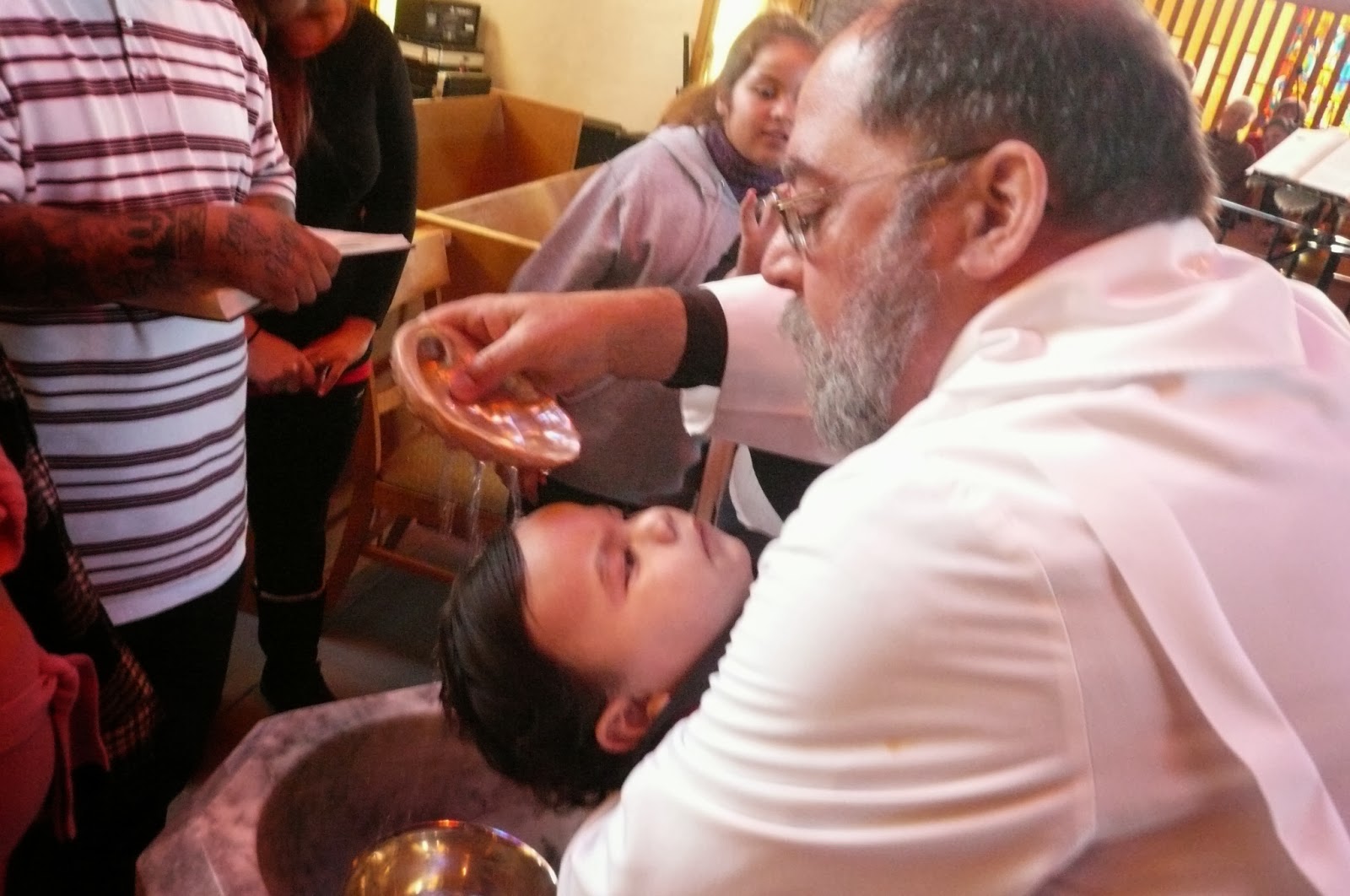
Baptism of Robert Anthony Michael Saadevra

Yesterday we welcomed Robert Anthony Michael Saadevera into the family of God and the family of All Saints'/Cristo Rey through the waters of baptism.

Friday, February 14, 2014

Feast of Cyril and Methodius, Missionaries to the Slavs


Today is St. Valentine's Day, but no one is really sure who this St. Valentine was. He may have been a Roman priest martyred during the reign of the Emperor Claudius in the mid third century, or he may have been the bishop of Terni, who was taken to Rome and martyred and whose remains were returned to Terni. The feast of St. Valentinus was once on the Roman calendar but he was dropped quite a while back, and now his day is more of a "Hallmark Holiday" a holiday for selling greeting cards, flowers, and chocolates.

Today is also the Feast of Saints Cyril and Methodius, two very important saints. Cyril and Methodius were brothers and lived in Thessalonica, a town where Christians were gathering very early in the history of the Church. Methodius was born around the year 815 and his brother Constantine was born around the year 826. Constantine studied philosophy and later became a monk, taking on the name of Cyril. As a philosophy student, Cyril also studied languages and was well-versed in Hebrew, Arabic, and even the Samaritan dialect. In the year 860, Photius, the patriarch of Constantinople selected Cyril and Methodius as the first missionaries to the Slavs. He chose them not only because Cyril was good with languages, but because as children both brothers spent a lot of time around the Slavs who lived in Thessalonica; they learned the Slavic language and were fluent in that language. They were the natural choice to be missionaries to the Slavs. Their first missionary trip in 860 was to the Khazars who lived north of the Caucasus region, but it was unsuccessful and the Khazars actually ended up accepting Judaism instead of Christianity. In the year 863, Rostislav, prince of Moravia (which is the area we now call the Czech Republic), requested Christian missionaries be sent. He had one requirement: that the missionaries be able to preach to the people in their own language and must do services in Slavonic, which meant that they needed Bibles and service books in Slavonic. So, before they even left for Moravia, the brothers started translating the Bible into Slavonic. There was not actual Slavonic alphabet so they had to invent one with which they would write their translations of the Bible and prayer books. The alphabet invented by St. Cyril is called Glagolithic and his followers invented another alphabet called Cyrillic which is the alphabet used in Russia and the former Eastern Block nations to this day. They translated the Bible into the dialect they had learned as boys, a Macedonian dialect of slavonic spoken around Thessalonica, an this language is now called Church Slavonic, and it is the liturgical language of the Russian Orthodox Church and the Slavonic Orthodox Churches. This is very important, because the Slavs were one of the few peoples who heard the gospel read in their own language instead of Greek or Latin, the major languages of the Church at that time. The Roman church always insisted that everything be done in Latin, but the Eastern church felt that it was important that services and readings be done in the vernacular of the people, the same concept which is accepted in the Anglican Communion. Cyril and Methodius ran into some trouble in Moravia and in Bulgaria; the Church in the West had sent German missionaries and they did not like the Greek Orthodox monks working in their area. The brothers were doing services in the language of the people while the Germans did everything in Latin; the brothers recited the Nicene Creed in its Eastern form without the filioque. In order to end German interference with the mission, Cyril asked for the protection of the Pope as he really didn't get involved in the East-West arguments and the Church was still united at that time; Cyril just wanted to continue working in Slavonic. The brothers traveled to Rome in 868 to speak to Pope Hadrian II, and he received them favorably and gave full support to their mission, allowing them to work in Slavonic, and even approved their translations of the Bible and service books. Unfortunately, Cyril died in Rome in 869, and when Methodius returned to Moravia, the Germans ignored the Pope's decision and obstructed him in every way; they even put Methodius in prison for a year!
When Methodius died in the year 885, the Germans ran his followers out of the country and even sold some of them into slavery (fine Christian people!). The Slavonic church lasted there for another two hundred years but then vanished; it seemed as if the mission of Cyril and Methodius had failed. but while their mission died in Moravia their translations moved in to Bulgaria, Serbia, and Russia, and Church Slavonic is the liturgical language of those areas. The Church grew and spread throughout that area and even lasted through fifty years of Communist oppression.

Some of the issues that Cyril and Methodius dealt with are still important today and are even important to us here in Panama. The issue of language is a very important issue here. I think that what saints Cyril and Methodius taught us is that it is important that people hear the gospel and worship in the language with which they are familiar, whether that language be English, Español, or Slavonic. When people hear the gospel in their own language the church takes root and grows. Cyril knew that it was important that the peoples of the Caucasus hear the Word in their own words and he was willing to go to those who spoke Latin to get the support he needed, because he knew that the Church is large enough to include everybody, whether they speak Español, English, Nippon-go, Hungarian, Greek or Slavonic, God hears us no matter what language we speak. What is important is that we remember that we are One Body, we are united as one body in Christ. One of the oldest Eucharistic prayers we have is in the Didache and it says "as this grain was once scattered over the hills and was brought together as one loaf of bread, so may your Church be brought together from the ends of the earth into your Kingdom." Let us take the example of saints Cyril and Methodius to heart realizing that the Church is One Body in Christ.

Almighty and everlasting God, by the power of the Holy Spirit you moved your servant Cyril and his brother Methodius to bring the light of the Gospel to a hostile and divided people: Overcome all bitterness and strife among us by the love of Christ, and make us one united family under the banner of the Prince of Peace; who lives and reigns with you and the Holy Spirit, one God, now and for ever. Amen.

Saturday, February 1, 2014

Feast of St. Brigid (Bride) of Cille-Dara

This is my St. Brigid's feast sermon

Today is the feast of St. Brigid, who is also called St. Bride. Next to St. Patrick, she is the most beloved of Irish saints. She is known as one who was generous, handsome, and brave. Born in Fauchart around the year 452, she may have actually met St. Patrick as a young girl. She was the daughter of a wealthy chief name Dubhtach and his slave Brocessa. According to the miracle-filled "Life of St. Brigid" written in the eighth century, she was baptized by three angels who also anointed her with oil. When Brigid was very young her mother was sold to a Druid, so she actually grew-up in a Druid household. She, however, was a Christian and remained true to her faith throughout her stay in that pagan household. A few years later she was returned to her father's household. She remained a slave but it seems that she had a special standing in the household. She became known for her generosity, especially her generosity with her father's possessions. Nothing was safe; she would give anything she owned away and once she ran out of things she would give away the belongings of the household. Once while watching a flock of sheep a poor young man came up to her and asked for some alms. She gave him one of the flock without question. He, however, having heard of her generosity, came back seven times that day, receiving a sheep each time. It seems that everyone in the village knew what was going on, but they were all shocked when, at the end of the day, Brigid returned with the flock and not one sheep was missing!

She was very beautiful and many young men approached her father asking for her hand, but Brigid told him that she didn't want to be married, she wanted to dedicate herself to the Lord. According to the Life of St. Brigid she prayed that God would disfigure her so that she would no longer be attractive to all the young men. While she was praying her eyeball melted (ew!), making her no longer attractive to the young men (or anyone else for that matter!). Her father was so angry at her that he decided to sell her to the King of Leinster. While her father was talking to the king, trying to set up a deal, she gave her father's sword to a poor person to sell for food. The king asked her why she gave away her father's sword, she answered, "I gave it to Christ, and if God asked me for all your wealth and the wealth of my father I would give it to the poor to please God." The king looked at her father and said,  "Your daughter is of far too much worth for me to buy and of even greater worth to be sold by you!" He sent Brigid and her father on their way. Her father finally allowed her to become a nun, and she received the veil from Bishop Macaile of Westmeath. In the year 470 she gathered seven young women with her and started a convent at at Cille-Dara, which means "Church of the Oak" in Gaelic. It is now known as Kildare. She wanted to insure that she and her nuns would always receive the blessed sacrament of holy communion, so she convinced a monk named Conlaed to be consecrated Bishop and had him and his monks bring their community to Cille-Dara. They established the first Irish double
monastery of men and women. Brigid was made Abbess of the monastery, becoming the first woman to lead both men and women religious. She also participated in policy-making decisions of the Celtic church. There are some stories that she was made a bishop but most scholars believe that this story may only reflect the fact that she exercised the jurisdictional authority that was wielded by an abbess.

As I mentioned earlier, Brigid was known for her generosity and love for the poor, and there are many stories of her generosity and miracles performed on behalf of the poor. Once she and her nuns were traveling in a carriage when they saw a poor man and his family walking along the road weighed down by their heavy burdens. Brigid stopped the carriage and gave the horses to the poor family. She and her nuns were stuck with a carriage and no horses. A captain heard of what Brigid had done and brought her two wild horses, which she immediately tamed and harnessed to the carriage. They resumed their travel when they met three lepers. Brigid stopped the carriage and this time gave the lepers the horses AND the carriage! Another time she had but one garment to give to two poor men. She tore the garment in half and it immediately became two perfectly good garments. Another story tells that she gave all the Bishop's vestments away to the poor for clothing (now that sounds like fun!). When the time came for the bishop to vest for the Mass, Brigid told him that she had given all the vestments away. Before he had time to react or answer her, a carriage appeared full of Episcopal Vestments which were even better  and more beautiful than the ones she gave away. She gave the Bishop the vestments he needed  and then gave the rest of the vestments and the carriage away to the needy. It was said that Brigid never let the poor leave her empty handed.

Brigid is also known for her great love for animals. There is a story about her taming a wolf for a local chieftain whose pet dog had been accidentally killed by a peasant. Here are two stories from The Life of St. Brigid:

Once a lone wild boar that was being hunted charged out of the forest, and in the course of its panicked flight careered into a herd of pigs that belonged to the most blessed Brigid. She noticed its presence and she blessed it. Immediately the creature lost its sense of fear and settled down quietly among the herd of pigs. See, my friends, how even the  wild beasts and animals could not resist either her bidding or her will, but served her docilely and humbly.
               
On another occasion the blessed Brigid felt a tenderness for some ducks that she saw swimming on the water and occasionally taking wing. She bid them fly to her, and a great flock of them flew toward her, without any fear, as if they were humans under obedience to her. She touched them with her hand and embraced them tenderly. She then released them and they flew into the sky. And as they did so she praised God the Creator of all living things, to whom all life is subject, and for the service of whom all life is gift.
               
From these and many other episodes that demonstrated her power, it is certain that blessed Brigid could command the affections of wild animals, cattle and the birds of the air.


Brigid died around the year 524, at Cille-dara. The cathedral in the town of Kildare were built on the foundations of her fire house. Her relics were moved to Downpatrick with those of St. Patrick during the time of the Danish invasions of the ninth century. Her cult was very popular in England and Scotland  and many churches there are named after her.

St. Brigid was the physical manifestation of the Celtic Ideals  of one who was Generous, Handsome, and Brave. She never let the poor leave empty-handed, she saw Christ in all people, and that is why we remember her today.

Everliving God, we rejoice today in the fellowship of your blessed servant Brigid, and we give you thanks for her life of devoted service. Inspire us with life and light, and give us perseverance to serve you all our days; through Jesus Christ our Lord, who with you and the Holy Spirit lives and reigns, one God, for ever and ever. Amen.

I've decided to add this poem by Phyllis Mcginly, titled The Giveaway:

Saint Bridget was
A problem child.
Although a lass
Demure and mild,
And one who strove
To please her dad,
Saint Bridget drove
The family mad.
For here's the fault in Bridget lay:
She Would give everything away.

To any soul
Whose luck was out
She'd give her bowl
Of stir about;
She'd give her shawl,
Divide her purse
With one or all.
And what was worse,
When she ran out of things to give
She'd borrow from a relative.

Her father's gold,
Her grandsire's dinner,
She'd hand to cold
and hungry sinner;
Give wine, give meat,
No matter whose;
Take from her feet
The very shoes,
And when her shoes had gone to others,
Fetch forth her sister's and her mother's.

She could not quit.
She had to share;
Gave bit by bit
The silverware,
The barnyard geese,
The parlor rug,
Her little niece's christening mug,
Even her bed to those in want,
And then the mattress of her aunt.

An easy touch
For poor and lowly,
She gave so much
And grew so holy
That when she died
Of years and fame,
The countryside
Put on her name,
And still the Isles of Erin fidget
With generous girls named Bride or Bridget.

 Well, one must love her.
 Nonetheless,
 In thinking of her
 Givingness,
 There's no denial
 She must have been
 A sort of trial
 Unto her kin.
 The moral, too, seems rather quaint.
 WHO had the patience of a saint,
 From evidence presented here?
 Saint Bridget?  Or her near and dear?

Friday, January 17, 2014

Feast of St. Anthony of Egypt

O God, by your Holy Spirit you enabled your servant Antony to withstand the temptations of the world, the flesh, and the devil: Give us grace, with pure hearts and minds, to follow you, the only God; through Jesus Christ our Lord, who lives and reigns with you and the Holy Spirit, one God, for ever and ever. Amen.

This is my St. Anthony sermon, edited for the Dance Party

Today is the feast of St. Anthony of Egypt. He was one of the first Christian monks and developed the monastic tradition in Christianity. What we know about him comes from “The Life of St. Anthony” by Athanasius, the Patriarch of Alexandria.

Anthony was born in the middle of the second century. around the year 251 to wealthy Christian parents. He had a younger sister. When he was twenty years-old his parents died and he and his sister inherited quite a lot of land. Anthony was a little troubled by this wealth and had been thinking about the Apostles and how they gave up everything to follow Jesus. Six months after his parents’ deaths he went to church and arrived as the gospel was being read. It was the story of the Rich Young Man, and he heard Jesus tell the young man “If you would be perfect, go sell what you possess and give to the poor, and you will have treasure in heaven.” Anthony took this gospel message seriously and actually went and gave most of his land to the villagers and sold his possessions, giving the money to the poor. Not long later, he heard the passage: “Do not be anxious about tomorrow” and sold the rest of his possessions, put his sister into a Christian Community of Dedicated Virgins, and went to the edge of the village to live the life of an anchorite. Anchorites were people who withdrew from the world to live solitary lives of silence, prayer, meditation and mortification. In those days anchorites lived along on the edges of towns. Much later, anchorites were closed into cells to spend their lives in prayer, and many times the cells were attached to churches. To live alone on the edge of the village was unusual, but Anthony later moved farther away from the village and lived in a tomb away from everyone. It was here that he had his first encounters with demons who would appear as wild beasts and beat him, at times leaving him near death. After fifteen years living on the edge of town in the tomb, he decided to withdraw completely, crossing the Nile and into the mountains where he found an abandoned fort. To live in the wilderness away from everyone, leaving civilization behind was like moving to the moon would be nowadays. He lived away from humanity, in the fort, for some twenty years. Pilgrims would come to see him but he avoided them. Some hermits came and lived in the caves around the fort, and eventually a community of hermits had developed, and they requested Anthony to come guide them in the spiritual life. He finally came out of seclusion around the year 305 and according to Athanasius, people were amazed that he didn’t look any different than he had when he had left the village twenty years earlier, “vigorous in body and mind.” He worked with this colony which had formed around him, developing a spiritual community and developing a rule of life. He did this for about six years and then decided to withdraw again. This became a kind of cycle for Anthony; he would live in community for a few years, then withdraw to the wilderness deeper and deeper each time, and, after several years of seclusion, return to civilization for a few years, eventually withdrawing once again. He withdrew to a mountain between the Red Sea and the Nile where a monastery in his name still stands. In the year 321 he came out of the desert and into Alexandria to help encourage and strengthen the martyrs of Maximinus’ persecution, and once again around the year 350 to preach against the Arians. According to Athanasius, Anthony was 105 years old when he died, and Jerome places his death around the year 357.

The form of monasticism developed by Anthony was dominant in Northern Egypt, while that of his disciple Pachomius was the form preferred in the South. He wasn’t a great organizer like Pachomius; he concentrated on getting a group of people living in separate caves and cells to work together. Athanasius describes the first monastery there in the mountains as follows: Their cells like tents were filled with singing, fasting, praying, and working that they might give alms, and having love an peace with one another. That’s what was most important to Anthony, that the brothers live together in love and unity, and not be fighting or in spiritual competition.

The Desert Fathers collected many sayings of, and about, Anthony. Here are a few of my favorites: When the holy Abba Anthony lived in the desert he was beset and attacked by many sinful thoughts. He said to God, “Lord, I want to be saved but these thoughts do not leave me alone; what shall I do in my affliction? How can I be saved?” A short while afterwards, when he got up to go out, Anthony saw a man like himself sitting at his work, getting up from his work to pray, then sitting down and plaiting a rope, then getting up again to pray. It was an angel of the Lord sent to correct and reassure him. He heard the angel saying to him, “Do this and you will be saved.” At these words, Anthony was filled with joy and courage. He did this, and he was saved.

He also said, “Our life and our death is with our neighbor. If we gain our brother, we have gained God, but if we scandalize our brother, we have sinned against Christ.”

He also said, “Some have afflicted their bodies by asceticism, but they lack discernment, and so they are far from God.”

A brother renounced the world and gave his goods to the poor, but he kept back a little for his personal expenses. He went to see Abba Anthony. When he told him this, the old man said to him, “If you want to be a monk, go into the village, buy some meat, cover your naked body with it and come here like that.” The brother did so, and the dogs and birds tore at his flesh. When he came back the old man asked him whether he had followed his advice. He showed him his wounded body, and Saint Anthony said, “Those who renounce the world but want to keep something for themselves are torn in this way by the demons who make war on them.”

Abba Anthony said, “A time is coming when men will go mad, and when they see someone who is not mad, they will attack him saying, ‘You are mad, you are not like us.’”

Abba Anthony said, “I no longer fear God, but I love him. For love casts out fear.”


Anthony took the gospel message seriously and lived a life which is a model for those called to solitary meditation. He didn’t want to draw attention to himself, and he had his burial place kept a secret so that it would not become a place of pilgrimage, remaining solitary in death just as he had in life.

Saturday, December 28, 2013

Feast of the Holy Innocents


Today is the Feast of the Holy Innocents, the kind of feast to which the proper response is: "ewwwww!" According to the story in Matthew's gospel, Herod ordered all the boys under two years old in Bethlehem to be slaughtered because he wanted to prevent the arrival of the Messiah. There are no accounts of this event in non-biblical literature of the time, and one would expect that such a traumatic event would appear somewhere; Flavius Josephus doesn't mention it, and he spent some time on the abuses of Herod.
Whether Herod had children massacred or not, there are still many innocents being slaughtered here in our own time. Children die of starvation all over the planet, and innocent children die in the war zones our our world, especially in Afghanistan, Iraq, Somalia, and Darfur. Innocent children die of abuse and neglect in developed nations and in developing nations. Innocent children die of neglect and abuse in the United States of America, too. Innocent children die every day on the streets of our cities. Innocent children were slaughtered in the shooting in Newtown just last year. The leaders of these nations are even more guilty than Herod, because we have actual proof of these atrocities taking place in our time.
So today, let us pray and remember the innocents massacred in this day and time around the world, and let's remember who is responsible for these modern-day atrocities.
We remember today, O God, the slaughter of the holy innocents of Bethlehem by King Herod. Receive, we pray, into the arms of your mercy all innocent victims; and by your great might frustrate the designs of evil tyrants and establish your rule of justice, love, and peace; through Jesus Christ our Lord, who lives and reigns with you, in the unity of the Holy Spirit,, one God, for ever and ever. Amen.

Friday, December 27, 2013

Feast of St. John, Apostle and Evangelist

This is my sermon on St. John

John, son of Zebedee and Salome and younger brother of James, grew up along the shores of the sea of Galilee. Both John and James were followers of John the Baptizer, and John and Andrew were present when John the Baptizer saw Jesus and said, “Behold the Lamb of God!” John was probably one of the earliest disciples of Jesus. Jesus called John and James “Boanerges” which means “Sons of Thunder” and they, along with Peter, where in the Inner Circle of the disciples. These three were blessed with the experience of seeing Jesus transfigured and talking with Moses and Elijah. When the women returned to tell the disciples of the empty tomb, both Peter and John ran to check out their story and John reached the empty tomb first. It was John who recognized the Resurrected Jesus sitting on the beach when they were fishing. According to the gospel attributed to John, Jesus gave the care of his mother, the Blessed Virgin Mary, to John as they stood at the foot of the cross. It was either James and John or their mother who asked Jesus if they could sit at his right and left when he entered his kingdom. We have no idea if they sit on either side of Jesus, but we do know that they shared the same cup as Jesus, the cup of persecution. James died the death of a martyr, but although John died in Ephesus at a very advanced age, he did suffer persecution. Tertullian and Jerome claim that during the persecution of Domatian, John was dipped in a cauldron of boiling oil outside the Latin Gate of the city of Rome. He was unharmed and was exiled to the island of Patmos to work in the mines. It was there that he received the vision which he wrote down and is named the Apocalypse of John the Divine, or the Book of Revelation.

John was the most prolific writer of the Twelve who followed Jesus; only the Apostle Paul left us more writings. John has a gospel attributed to him, the vision of the Apocalypse is attributed to him, and three letters to the Church in Ephesus are attributed to him. According to bishop Eusebius of Cesarea, the fourth century historian, John wrote his gospel because the other three gospels did not deal with the deeds of Jesus at the beginning of his ministry. Eusebius said that John’s gospel was accepted by the Church from the earliest days, as well as the first epistle attributed to him, but that the other two epistles are not accepted by everyone. There was still disagreement as to whether the Apocalypse should be accepted as scripture in the fourth century; Eusebius writes: “In regard to the Apocalypse, the opinions of most men are still divided.” As I mentioned earlier, John moved to Ephesus upon his release from Patmos, and he became a very important part of the Church in Asia. St. Jerome writes that towards the end of John’s life in Ephesus, he was so weak that he could no longer preach or even stand. His young disciples would carry him into the church and, with great difficulty, the Apostle would say: "My dear children, love one another." Some of those in the congregation once asked him why he always said the same thing, why he repeated the same words, and the Apostle answered, "Because it is the precept of the Lord, and if you comply with it, you do enough " He finally died in peace in Ephesus, at about ninety-four years of age. As far as we know, John is the only one of the Apostles who died of old age rather than receiving the crown of martyrdom.

I want to finish by relating a story about the Apostle which Eusebius credits to Clement of Alexandria. This story gives us great insight into the nature of John: "Listen to a tale, which is not a mere tale, but a narrative concerning John the apostle, which has been handed down and treasured up in memory. For when, after the tyrant's death, he returned from the isle of Patmos to Ephesus, he went away upon their invitation to the neighboring territories of the Gentiles, to appoint bishops in some places, in other places to set in order whole churches, elsewhere to choose to the ministry some one of those that were pointed out by the Spirit. When he had come to one of the cities not far away, and had consoled the brethren in other matters, he finally turned to the bishop that had been appointed, and seeing a youth of powerful physique, of pleasing appearance, and of ardent temperament, he said, 'This one I commit to thee in all earnestness in the presence of the Church and with Christ as witness.' And when the bishop had accepted the Charge and had promised all, he repeated the same injunction with an appeal to the same witnesses, and then departed for Ephesus. But the presbyter, taking home the youth committed to him, reared, kept, cherished, and finally baptized him. After this he relaxed his stricter care and watchfulness, with the idea that in putting upon him the seal of the Lord he had given him a perfect protection. But some youths of his own age, idle and dissolute, and accustomed to evil practices, corrupted him when he was thus prematurely freed from restraint. At first they enticed him by costly entertainments; then, when they went forth at night for robbery, they took him with them, and finally they demanded that he should unite with them in some greater crime. He gradually became accustomed to such practices, and on account of the positiveness of his character, leaving the right path, and taking the bit in his teeth like a hard-mouthed and powerful horse, he rushed the more violently down into the depths. And finally despairing of salvation in God, he no longer meditated what was insignificant, but having committed some great crime, since he was now lost once for all, he expected to suffer a like fate with the rest. Taking them, therefore, and forming a band of robbers, he became a bold bandit-chief, the most violent, most bloody, most cruel of them all. Time passed, and some necessity having arisen, they sent for John. But he, when he had set in order the other matters on account of which he had come, said, 'Come, O bishop, restore us the deposit which both I and Christ committed to thee, the church, over which thou presidest, being witness. But the bishop was at first confounded, thinking that he was falsely charged in regard to money which he had not received, and he could neither believe the accusation respecting what he had not, nor could he disbelieve John. But when he said, 'I demand the young man and the soul of the brother,' the old man, groaning deeply and at the same time bursting into tears, said, 'He is dead.' 'How and what kind of death?' 'He is dead to God,' he said; 'for he turned wicked and abandoned, and at last a robber. And now, instead of the church, he haunts the mountain with a band like himself.' But the Apostle rent his clothes, and beating his head with great lamentation, he said, 'A fine guard I left for a brother's soul! But let a horse be brought me, and let some one show me the way.' He rode away from the church just as he was, and coming to the place, he was taken prisoner by the robbers' outpost. He, however, neither fled nor made entreaty, but cried out, 'For this did I come; lead me to your captain.' The latter, meanwhile, was waiting, armed as he was. But when he recognized John approaching, he turned in shame to flee. But John, forgetting his age, pursued him with all his might, crying out, 'Why, my son, dost thou flee from me, thine own father, unarmed, aged? Pity me, my son; fear not; thou hast still hope of life. I will give account to Christ for thee. If need be, I will willingly endure thy death as the Lord suffered death for us. For thee will I give up my life. Stand, believe; Christ hath sent me.' And he, when he heard, first stopped and looked down; then he threw away his arms, and then trembled and wept bitterly. And when the old man approached, he embraced him, making confession with lamentations as he! was able, baptizing himself a second time with tears, and concealing only his right hand, But John, pledging himself, and assuring him on oath that he would find forgiveness with the Saviour, besought him, fell upon his knees, kissed his right hand itself as if now purified by repentance, and led him back to the church. And making intercession for him with copious prayers, and struggling together with him in continual fastings, and subduing his mind by various utterances, he did not depart, as they say, until he had restored him to the church, furnishing a great example of true repentance and a great proof of regeneration, a trophy of a visible resurrection."

John is also called the Apostle of Charity, a virtue which is very much on our minds at this time of year. I will leave you with these words from John’s first epistle, which remind us why we remember him today:"Everyone who believes that Jesus is the Christ has been born of God, and everyone who loves the parent loves the child. By this we know that we love the children of God, when we love God and obey his commandments. For the love of God is this, that we obey his commandments. And his commandments are not burdensome, for whatever is born of God conquers the world. And this is the victory that conquers the world, our faith. Who is it that conquers the world but the one who believes that Jesus is the Son of God?"

Shed upon your Church, O Lord, the brightness of your light, that we, being illumined by the teaching of your apostle and evangelist John, may so walk in the light of your truth, that at length we may attain to the fullness of eternal life; through Jesus Christ our Lord, who lives and reigns with you and the Holy Spirit, one God, for ever and ever. Amen.

Thursday, December 26, 2013

Feast of St. Stephen, Proto-martyr


We give you thanks, O Lord of glory, for the example of the first martyr Stephen, who looked up to heaven and prayed for his persecutors to your Son Jesus Christ, who stands at
your right hand; where he lives and reigns with you and the Holy Spirit, one God, in glory everlasting. Amen.


We don't have much information on St. Stephen, the Protomartyr. All the information we have comes from chapters 6 and 7 of the Acts of the Apostles, the second volume of the work attributed to St. Luke. One of the first disputes in the early Church involved the assistance programs for needy widows, and this dispute fell along the lines of language, as the Greek-speaking members of the community in Jerusalem complained that their widows were being ignored in favor of the widows of the Aramaic speakers. The apostles were fed-up with the dispute and realized that they couldn't go out and preach the Good News and take care of administrative and financial matters, so they told the community to select seven persons from the group, persons who were respected and of sound judgement and filled with the Holy Spirit. Seven men were selected, and among them was Stephen.

Stephen was quite a preacher. His sermons brought folks to repentance and to seek baptism, but his sermons could also really anger those in authority. One day he went too far and was stoned by a mob who had become enraged by his sermon. I guess they didn't like being called "stiff-necked people, uncircumcised in heart and ears, forever opposing the Holy Spirit." They dragged him outside of the city and stoned him, leaving their coats with one Saul, who approved of their killing him. Stephen didn't hold their anger against them, saying, "Lord, do not hold this sin against them" just as he died. I guess that's one reason not to call people names when preaching.